
Every day in India, families pack their most precious belongings into boxes, hand them over to strangers, and hope for the best. For 83 of those families, that hope is shattered — by fake packers and movers who steal, extort, and disappear.
Relocating your home is one of the most emotionally and financially significant events of your life. You are trusting someone with your furniture, your electronics, your children’s memories, your grandmother’s jewellery, and your life’s hard-earned possessions. Yet thousands of Indian families — including hundreds in Gujarat every month — fall victim to fraudulent moving companies that operate with complete impunity, hiding behind professional-looking websites, fake reviews, and stolen brand names.
This blog is a comprehensive awareness guide that brings together the most critical things you must know before hiring any packers and movers company in India. It covers how these scams work, the warning signs to watch for, real stories from Gujarat families, and most importantly — exactly how to protect yourself.
Why 83 Families Lose Their Belongings to Fake Movers Every Day in India
Key Statistics
| 83+ Families cheated by fake movers every single day in India | ₹20K Cr+ Annual size of India’s largely unregulated moving industry | 70% Customers choose movers based on price alone — the biggest mistake | 1 in 3 Moving complaints involve goods held hostage or damaged beyond repair |
Industry awareness campaigns by established relocation companies have highlighted a chilling reality: over 83 customers are defrauded by fraudulent packers and movers companies every single day across India. That is more than 30,000 families every year whose belongings are lost, damaged, held hostage, or simply never delivered — and whose money disappears with the so-called mover.
The Indian relocation industry, valued at over ₹20,000 crore annually, is one of the least regulated consumer service sectors in the country. Anyone with a truck, a phone number, and a website can set themselves up as a ‘professional packer and mover’ overnight. There is no mandatory licensing, no minimum insurance requirement, and no centralised registry of complaint records that customers can check before booking.
This regulatory vacuum is exactly what fraudulent operators exploit. They invest in paid Google ads using names nearly identical to reputable brands — sometimes differing by just one letter or a hyphen. They create fake customer reviews, fake certificates, and fake office addresses. By the time a customer realises something is wrong, their goods are already in an unknown truck heading to an unknown destination.
⚠️ HOW THE TRAP IS SET
Fake movers typically offer quotes 30–50% below market rates to hook price-sensitive customers. Once your goods are loaded, the price suddenly escalates — and your belongings become the leverage. Pay the inflated amount or never see your goods again. This is not a rare occurrence. It is a systematic, organised scam operating across every major city in India.
How Fake Packers and Movers Scam Families in India
Understanding how these scams operate is the first step to avoiding them. Fraudulent moving companies are not amateur criminals — many operate sophisticated networks with call centres, fake websites, and multiple registered phone numbers that make them appear entirely legitimate to an unsuspecting customer.

The Low-Quote Hook
The scam almost always begins with an irresistibly low quote. A legitimate packer and mover in India will quote based on actual distance, volume of goods, packing materials, labour, and insurance. A fake mover ignores all of these variables and simply quotes whatever number it takes to win your booking — typically 30 to 50 percent below what genuine companies charge. This below-market quote is the bait.
The Goods-Loading Stage
Once you accept the quote, the fake mover sends a team to your home. At this stage, everything appears professional. Goods are packed — often poorly, using cheap or reused materials — and loaded into a vehicle. A receipt or inventory list may or may not be provided. The customer feels reassured because the process seems to be going smoothly.
The Mid-Transit Extortion
This is where the scam escalates. Mid-transit — sometimes hours, sometimes days after loading — the ‘mover’ contacts the customer with a new, dramatically higher bill. Common pretexts include additional fuel charges, toll charges, extra labour charges, or suddenly discovered insurance requirements. The customer is told that unless the additional amount is paid immediately, the goods will not be delivered.
The Disappearing Act
In the worst cases, the fake mover simply disappears entirely. The phone numbers stop working. The website goes offline. The office address turns out to be a vacant lot or someone else’s business. The truck — and all your belongings — are gone. Recovering from this type of fraud through legal channels can take years, and recovery of goods or money is rarely guaranteed.
⚠️ THE REAL COST
Beyond the monetary loss — which ranges from ₹15,000 to ₹5,00,000 depending on the size of the move — victims of fake mover fraud suffer significant emotional distress. Family heirlooms, irreplaceable photographs, children’s school records, and medical documents are often lost permanently. No amount of compensation can restore what is truly lost.
The ₹50,000 Mistake: Real Stories of Families Cheated by Fake Movers in Gujarat
Gujarat — one of India’s most economically dynamic states — has seen a sharp rise in fake mover fraud as rapid urbanisation and industrial growth drive increasing inter-city migration. From Ahmedabad to Surat, Vadodara to Rajkot, families across Gujarat have paid a heavy price for trusting the wrong company.
| 📍 AHMEDABAD, GUJARAT | Family of 4 — Shifting from Satellite to Bopal Family of 4 — Shifting from Satellite to Bopal | Loss: ₹48,000 |
A family relocating within Ahmedabad booked a mover through a sponsored Google ad. The original quote was ₹12,000 — well below competing quotes of ₹18,000–₹22,000. After goods were loaded, the driver called to say additional charges of ₹36,000 were applicable for ‘staircase loading, extra packing material, and insurance.’ The family paid under pressure. On delivery, a 55-inch television was cracked, an antique wooden cabinet was broken, and several cartons of kitchenware were missing. The company’s phone was unreachable within 48 hours of delivery.
| 📍 SURAT, GUJARAT | Textile Businessman — Relocating to Vadodara Textile Businessman — Relocating to Vadodara | Loss: ₹1,20,000 |
A businessman shifting his home from Surat to Vadodara booked a company that claimed to be ‘IBA certified’ — a claim it had no documentation to support. The original quote of ₹35,000 was doubled mid-route. When the businessman refused to pay the extra amount, his goods were kept in the truck for three days. He ultimately paid ₹70,000 to retrieve his belongings, which arrived with significant damage to electronics and furniture.
| 📍 RAJKOT, GUJARAT | Retired Bank Officer — Moving to Gandhinagar Retired Bank Officer — Moving to Gandhinagar | Loss: ₹62,000 |
A retired bank officer trusted a company with a name strikingly similar to a well-known national brand. The branding, website, and even the uniforms of the packers appeared professional. However, no proper inventory was created before loading. On arrival in Gandhinagar, several boxes were missing entirely, and the delivery crew demanded a cash tip to unload. The company denied responsibility for missing items, citing a clause buried in fine print.
These are not isolated incidents. They represent a pattern of organised fraud that targets families during one of the most vulnerable moments of their lives — when they are busy, stressed, and simply trying to move forward. The common thread in every story: the customer chose based on price, without verifying credentials.
Held Hostage: How Fake Packers and Movers Trap Your Goods and Demand Extra Money
The ‘goods hostage’ scam is the most financially and emotionally devastating variation of moving fraud. Once a fake mover has your belongings in their truck, you are at their mercy. The psychological pressure of knowing that everything you own is in a vehicle driven by someone who has effectively become your adversary is immense.
Fake movers who use this tactic are typically well-practised in it. They know that most customers will pay rather than risk losing their goods entirely. They also know that pursuing legal action is slow, expensive, and uncertain — making extortion a relatively low-risk business model.
⚠️ THE HOSTAGE PLAYBOOK — STEP BY STEP
Step 1: Win the booking with a suspiciously low quote.
Step 2: Load all goods and begin transit — goods are now out of your control.
Step 3: Call mid-route with inflated additional charges (2x to 5x original quote).
Step 4: Threaten to divert the truck to a warehouse and charge storage fees.
Step 5: Demand cash payment — no receipts, no records — before delivery.
Step 6: Deliver goods in damaged condition with no accountability.
The single most effective protection against the goods-hostage scam is choosing a verified, credentialled moving company before a single box is packed. A company with IBA approval, proper GST registration, documented insurance, and a physical verifiable office has too much to lose to engage in extortion.
10 Warning Signs Your Packers and Movers Company is FAKE
Before you sign anything or pay any advance, run through this checklist. If your mover triggers even two or three of these warning signs, walk away immediately.
| Quote 30–50% below market rate Legitimate movers cannot profitably operate at rates this low. A suspiciously cheap quote is bait, not a bargain. |
| No physical office address Cannot be located on Google Maps or verified in person? Ghost companies have ghost offices. |
| No GST registration number Ask for the GST number and verify it at gst.gov.in. No GST = no legitimate business registration. |
| Cannot provide IBA approval IBA empanelment is verifiable. If they claim IBA approval but cannot show the certificate, they are lying. |
| Demands large cash advance upfront Established movers take a modest booking advance. Demanding 50–70% upfront in cash is a scam signal. |
| No written, itemised quotation A verbal or vague quote gives you zero legal protection when the price doubles mid-move. |
| No transit insurance documentation Any company that cannot provide a real, active transit insurance policy leaves your goods completely unprotected. |
| Reviews are all 5-star and recent A profile with only glowing reviews posted within the last 3–6 months is almost certainly fabricated. |
| Name similar to a well-known brand Fake companies often use names nearly identical to trusted brands — differing by one word, spelling, or hyphen. |
| Refuses to create a proper inventory A professional mover documents every item before loading. Refusal means no accountability for missing goods. |
How to Protect Yourself — The 5-Step Verification Process
The good news is that protecting yourself from fake movers is entirely within your control, if you take the right steps before booking.
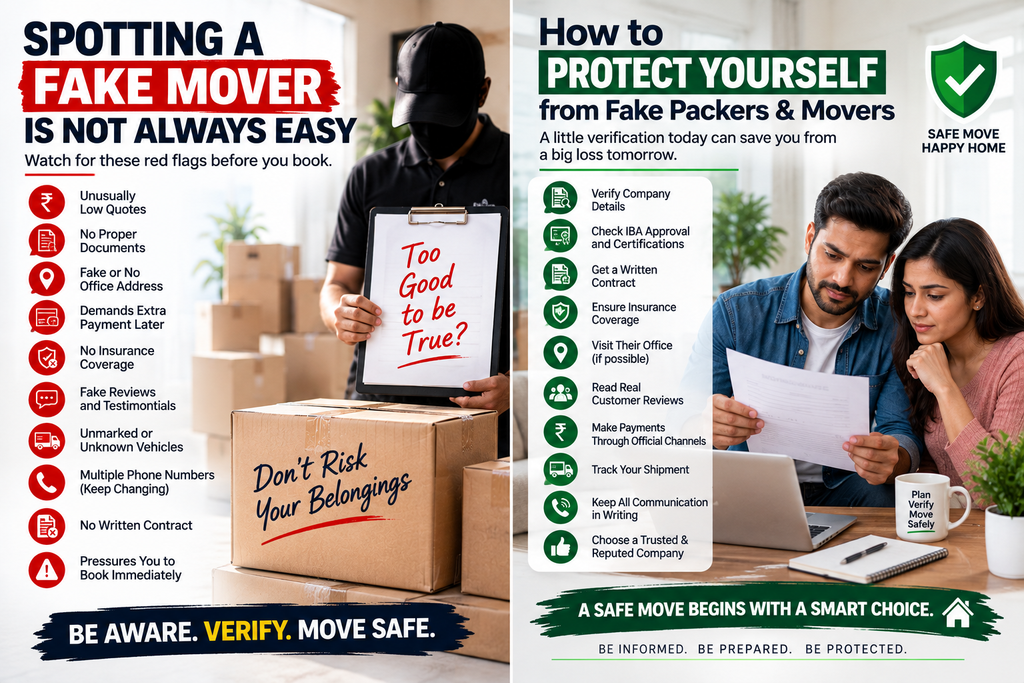
| Verify IBA Empanelment Ask the company for their IBA empanelment certificate and cross-check against the official IBA list. IBA-approved movers have been vetted by India’s apex banking body — the highest available standard of verification for relocation services. |
| Check GST and Company Registration Verify the company’s GST number at gst.gov.in and their CIN at the Ministry of Corporate Affairs portal at mca.gov.in. A legitimate company will have both readily available. |
| Confirm Active Transit Insurance Request a copy of the transit insurance policy and call the insurer’s helpline to confirm the policy is active and covers your move. Do not accept a photocopy of an expired or generic policy. |
| Insist on a Written, Itemised Quote Before any payment is made, get a detailed written quotation that itemises every charge — packing, labour, transport, insurance, loading, unloading, and applicable taxes. Sign only after reviewing every line. |
| Create a Detailed Inventory Before Loading Insist on a room-by-room written inventory of all items being moved, signed by both parties before the truck is loaded. Photograph high-value items. This is your only legal protection if goods are damaged or go missing. |
✅ THE SAFEST CHOICE
All of the verification steps above are standard operating procedure for IBA Approved Packers and Movers — companies like ARG Relocations that operate under institutional oversight. Choosing an IBA-approved mover doesn’t just protect your goods. It protects your peace of mind.
🚚 CONTACT ARG RELOCATIONS FOR SAFE HOME RELOCATION SERVICES
Don’t risk your most precious belongings with an unverified mover.
✅ Household Shifting ✅ Office Relocation ✅ Car & Bike Transport ✅ Packing & Storage ✅ Pan India Coverage
📞 Office: +91 93 7626 1616 📞 All India: +91 9466161616
🌐 argpackersmovers.com | “With You — All The Way”
Conclusion: Your Move Should Be a New Beginning — Not a Nightmare
Moving home is a milestone. It should feel like the exciting start of a new chapter — not the beginning of a legal battle to recover your stolen possessions. The fraud epidemic in India’s relocation industry is real, it is serious, and it is growing. But it is entirely avoidable.
The 83 families who are cheated every day are not naive or careless. They are simply uninformed — about what to look for, what to ask, and what credentials actually mean. Now that you know the warning signs, the scam playbook, and the five-step verification process, you are equipped to make the right choice.
Always choose IBA Approved Packers and Movers. Always insist on written documentation, verified insurance, and a proper inventory. And if a quote sounds too good to be true — it is. Your belongings are worth more than a discount. Trust only those who have earned that trust through verified credentials and institutional accountability.